
Pilot Studies
Review some of the EIRENE-AT pilot studies that demonstrate the scientific capabilities of our infrastructure by applying advanced exposomics technologies to real-world research questions.
These projects serve as proof-of-concept studies, validate emerging analytical workflows and support the development of future infrastructure services.



Combining Exposomics and Metallomics
Pilot Summary
In a proof-of-principle study, sample preparation strategies for assessing the inorganic and organic parts of the human exposome from single sample aliquots was developed. Therefore, ICP-MS analysis of the elemental composition of human blood and tissue samples in residues from sample extracts and protein precipitates, which are typically discarded after LC-MS analysis, could be demonstrated. The combined methodology offers and elegant tool for the analysis of small sample amounts (e.g., 50 µL or 50 mg) which is especially useful for studies with limited sample availability. As a proof of principle, the resulting workflow was applied to human cord blood plasma, cord whole blood and placental tissue samples.
The exposome and birth outcomes
Pilot Summary
In this pilot study, the chemical exposome in matched cord blood, maternal blood and placental tissue samples was assessed using LC-MS/MS and ICP-MS and placental transfer ratios were derived from quantitative results. Moreover, LC-HRMS was used to expand chemical coverage and identify potential metabolic biomarkers for preeclampsia, birth outcomes and related health conditions.
Watch a 20-minute presentation on this pilot!
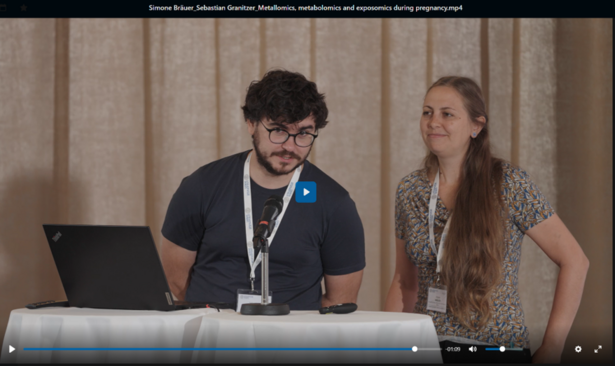
Topic: Metallomics, metabolomics and exposomics during pregnancy
Venue: 1st Exposome Austria Symposium & Open Stakeholder Day, Sept 23, 2025 (Horn)
Time: 00:19:29
Light Meter Study
Pilot Summary
This project aims to simultaneously characterize chemical exposure and the metabolome in longitudinal urine samples collected over three days from day- and night shift nurses participating in the Nurses’ Health Study II. The cohort is supported by extensive epidemiological data, enabling comprehensive statistical analyses. Individual light exposure data collected during the sampling period further complement the dataset.